From Bookstores to Bots, Does Using AI for Writing Feel Like Cheating?

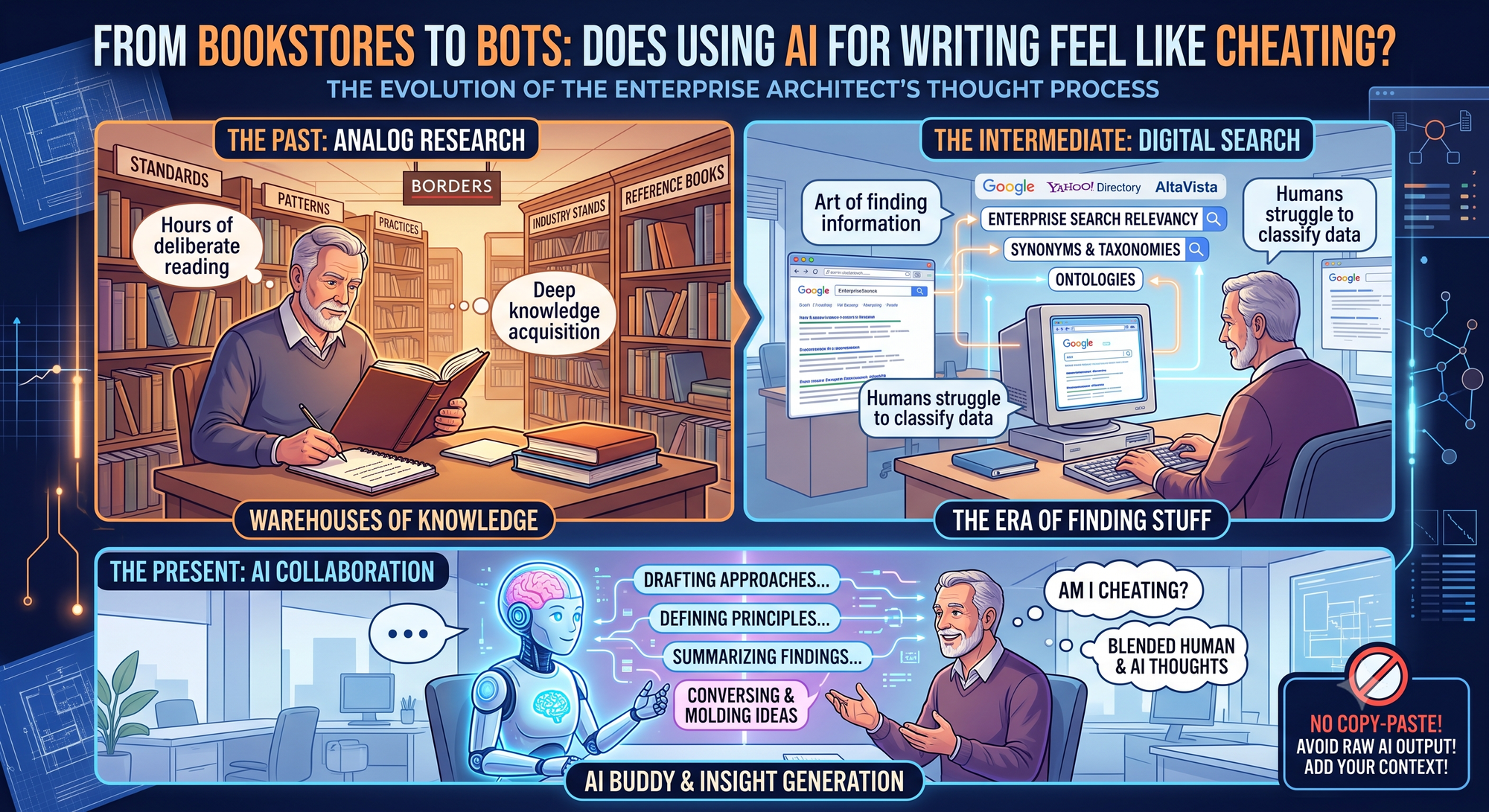
As an enterprise architect and solution designer, a significant portion of my job revolves around writing. I am constantly drafting positions, defining approaches, and establishing the guiding principles for where our technology is heading. Historically, this level of strategic writing has always relied on deep, continuous research.
Lately, however, the process has changed so drastically that I find myself asking a strange question: Does using AI to help formulate these thoughts feel like cheating?
To understand why I ask this, it helps to look back at how the art of research has evolved over the span of my career.
The Analog Era: Warehouses of Knowledge
When I first started out, the World Wide Web did not exist. To stay up to date on industry standards, architectural patterns, and emerging practices, I relied entirely on physical books.
I would spend hours in bookstores like Borders and Barnes & Noble—massive warehouses of information—buying and reading constantly. That was the only way to understand how things were done and where the industry was going. Knowledge acquisition was deliberate, physical, and time-consuming.
The Dawn of the Web and the Art of Search
Eventually, technology started to catch up. My access expanded through CompuServe, local bulletin boards, and AOL. Then came Yahoo, which began categorizing the web into a structured directory, making things significantly easier to find. That evolved into AltaVista, Ask Jeeves, and finally, Google.
Suddenly, we had the ability to search the entire web, and for years, that became my modus operandi. Whenever I had a topic to research, I would simply search. I began to consider myself an artist in the way I could track down obscure information. (My wife would even jokingly volunteer my services to her friends because I always knew exactly how to query the web to find what they needed).
This passion for search eventually led me into internal organizations where I helped build enterprise search capabilities. I learned the deep mechanics of information retrieval:
- Boost and barrier rules
- Relevancy tuning
- Synonyms, taxonomies, and ontologies
Through that work, I also learned the harsh reality that relying entirely on humans for manual tagging, segmentation, and classification is neither effective nor scalable.
The AI Paradigm Shift
When modern AI arrived, I was immediately impressed by its ability to bypass those human limitations, and specifically its capacity to summarize massive amounts of data and organize it into structures that actually made sense.
Now, whenever I need to write a position piece or put complex thoughts together, I talk to my AI. We converse and bounce ideas back and forth. I lead the discussion and have to filter out the noise, but the ability of AI models to search and coalesce data into a consumable knowledge base is stunning to me.
The speed at which I can now produce high-quality content absolutely blows me away. But because it is so fast and efficient, I sometimes catch myself thinking “Wow, this feels like cheating. Am I still actually doing my job, or is this thing doing my job for me?”
The "Copy-Paste" Pet Peeve
This dilemma has given rise to a new, evolving pet peeve of mine. Frequently, someone will say to me, "Hey Mike, I put this prompt into an AI chat, and here is what it said," and then they simply copy and paste the raw output directly to me.
To me, that adds zero value.
When you use AI, I don't just want the machine's raw output. I want your context. I want you to read what the AI generated, mold it, correct it, and structure it into something meaningful for our specific situation. AI is a tool for thought, not a replacement for it.
The Blended Mind: Whose Thoughts Are They?
I have no reservations about using AI for writing code. Building apps with AI assistance is phenomenal. It's not cheating, it’s just awesome.
But when it comes to utilizing AI to structure my professional thoughts and architectural principles, the lines get blurrier. Are they still strictly my thoughts? Are they the AI’s thoughts? Or have we entered an era in which our professional output is simply a blend of collaborative thought?
It is a fascinating shift in how we work, and I am incredibly curious to hear where others stand. Do you feel like utilizing AI to shape your writing is cheating, or is it just the next natural evolution of research? Oh and full disclosure AI helped me clean this article up.