Stop Asking for an "AI Strategy"

Why AI is just another tool in the EA toolbox—and how to actually use it to enable business strategy.
Stop Asking for an "AI Strategy"
Why AI is just another tool in the EA toolbox—and how to actually use it to enable business strategy.
Walk into any boardroom today, and you’ll hear the same urgent question from CEOs and Board members: “What is our AI strategy?” Everyone is treating AI as the ultimate must-have.
As an Enterprise Architect, my response usually stops them in their tracks: You shouldn't have an AI strategy.
An AI strategy implies that technology itself is the end goal. It isn't. AI is simply another powerful tool in our technological toolbox. Years ago, when I was working for a large software company, I used to remind my teammates that clients didn't buy our platform just to build out technology, they bought it to deliver business value. The technology was just the enabler.
The same rule applies to AI today. The question shouldn't be “What is your AI strategy?” It needs to be “How are we going to use AI to enable and accelerate our actual business strategy?”
Real enterprise transformation is about managing change. It’s about orchestrating the shift from your current state to your future state through smart, controlled transitions. To cut through the AI hype and protect your bottom line, leadership must stop treating AI as a shiny object and start shaping it into a structured, governed, and repeatable framework.
The Three Pillars of Enterprise AI Demand
When business units approach IT wanting to "do something with AI," the requests are usually vague, highly enthusiastic, and completely unmapped. As an Enterprise Architect, my job is to take that raw demand and shape it into something actionable, measurable, and architecturally sound.
To do this, I break every single request down into three distinct operational pillars. Think of these pillars as a spectrum of complexity, moving from basic user enablement to full system autonomy.
By filtering every project through this three-pillar lens, we can immediately identify the exact level of process maturity, integration, and security guardrails required to make the project a success. Here is how they break down.
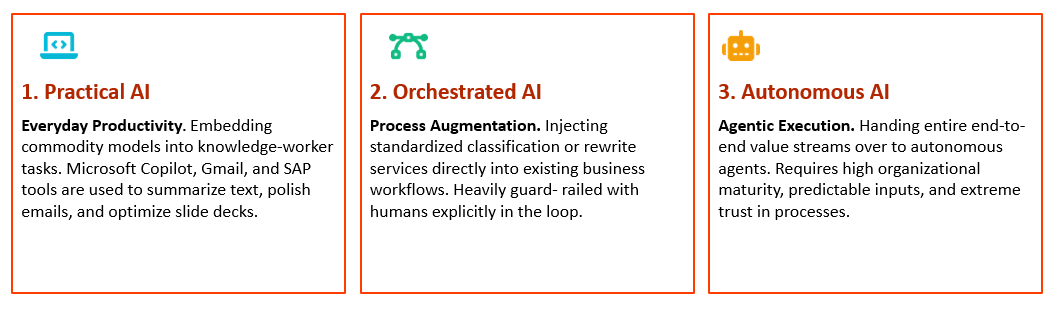
| Pillar | Focus | Human-in-the-Loop? | Core Architectural Challenge |
|---|---|---|---|
| 1. Practical AI | Desktop & Knowledge Worker Productivity | Fully Embedded | Scale, Licensing, & Data Leakage |
| 2. Orchestrated AI | Business Process Optimization & Workflows | Heavily Guardrailed | API Proliferation & Redundant Services |
| 3. Autonomous AI | End-to-End Task Delegation & Agentic Execution | Exception Handling Only | Process Maturity, Trust, & FinOps |
Pillar 1: Practical AI (Everyday Productivity)
Practical AI focuses on embedding intelligent capabilities into the daily workflows of your knowledge workers.
- The Goal: Empower employees to write better emails, summarize documents, generate text-to-speech, manage imagery, and build presentations faster.
- The Reality: This is AI at the commodity level. It is embedded directly into the tools your enterprise already uses—Microsoft Copilot, Google Workspace, SAP, and Adobe.
- The EA Perspective: The challenge here isn't building models; it’s rolling them out at scale while mitigating data sprawl.
Pillar 2: Orchestrated AI (Process Augmentation)
Orchestrated AI injects intelligent services directly into core business processes to optimize and scale operations.
- The Goal: Use AI to augment human decision-making within an established workflow (e.g., automated document classification, routing, or text rewriting).
- The Reality: Humans remain firmly in the loop. AI handles the heavy cognitive lifting, but a human manages the ultimate output.
- The EA Perspective: Without enterprise-level orchestration and SOA (Service-Oriented Architecture) principles, you will end up with five different business units building five different ways to classify data. Architects must extract these capabilities and deliver them as standardized, reusable enterprise services.
Pillar 3: Autonomous AI (Agentic Execution)
Autonomous AI refers to handing entire business processes or complex task sequences over to AI models and agents.
- The Goal: Handing over invoice processing, object tracking, or complex data reconciliation to autonomous agents that execute based on high-level prompting.
- The Reality: We are generally not there yet. Fully autonomous execution requires an immense level of organizational trust, precise guardrails, and rigorous continuous monitoring. I have seen pockets of small-scale success and read horror stories of mitigated disasters.
The Ultimate Architectural Principle: "Always is Cheap, Sometimes is Expensive"
To move up these pillars, especially toward autonomy, an enterprise must confront its own operational maturity.
Throughout my career, I have lived by my foundational architectural principle: Always is cheap; sometimes is expensive.
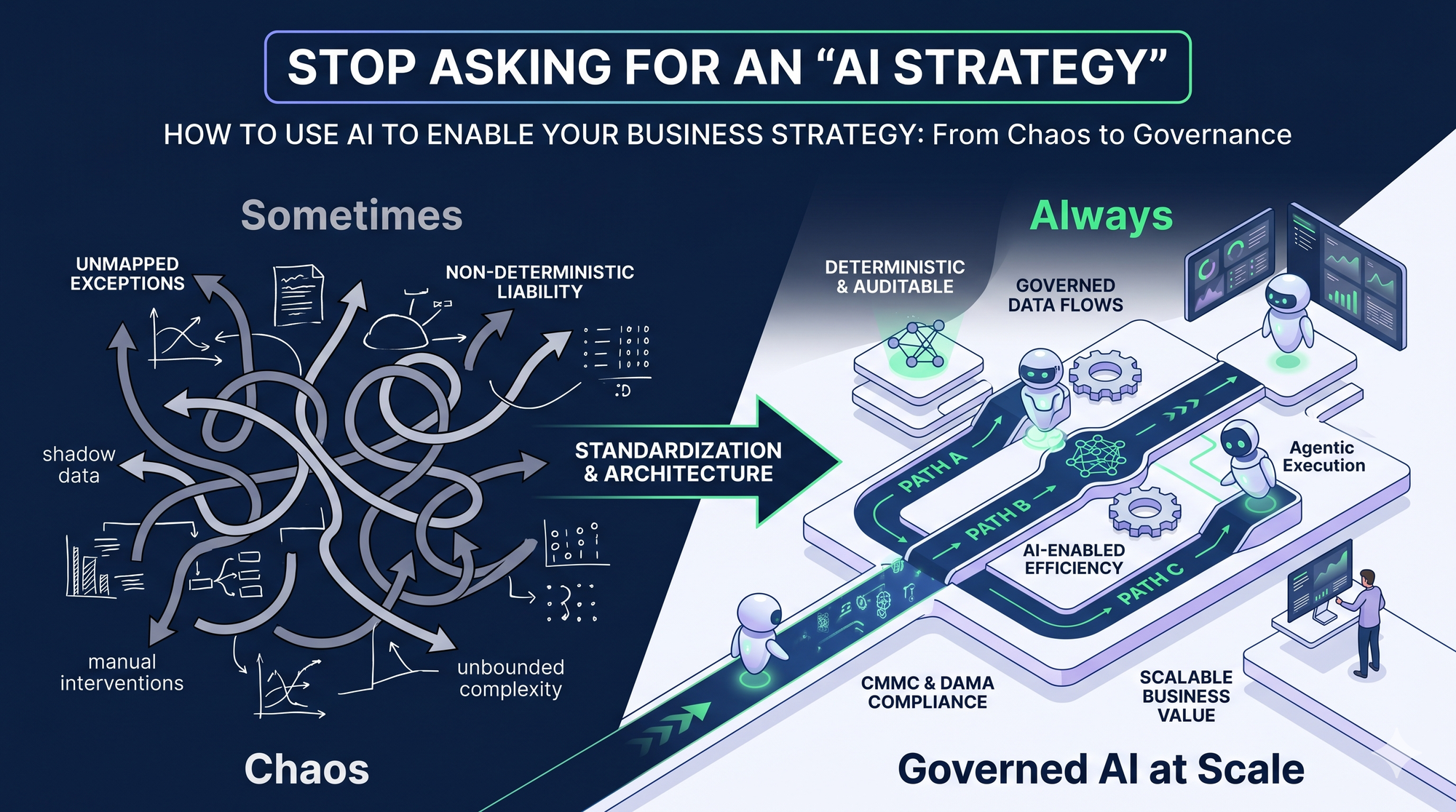
When interviewing business leaders about their current state, they often describe their workflows using the word "sometimes":
"Well, sometimes we process it this way, but sometimes we route it over there, and occasionally we handle it manually..."
This is chaos. If a business cannot articulate a clear, traceable reason for these deviations, the process is too immature to support advanced technology.
A common pushback from business teams is: “But can’t a sophisticated autonomous agent just figure out the 'sometimes' for us? Isn’t that the whole point of AI?”
While technically possible, relying on AI to navigate the chaos of undocumented processes is an operational disaster waiting to happen. We get the “Illusion of "Agentic Flexibility."
When an agent handles an unmapped exception, it operates non-deterministically. It makes a statistical guess. In a tightly regulated enterprise, allowing an unguided agent to decide how to route data or execute financial transactions violates basic DAMA data governance and CMMC security compliance requirements. Without explicit, data-driven rules, you lose track of traceability. You cannot audit a statistical guess.
Therefore, to leverage AI effectively, we must drive toward an "Always" standard. We build standardized platforms in which a process follows paths A, B, or C based on explicit, data-driven criteria. AI should be used to accelerate execution along those paths, or intelligently flag true anomalies to a human-in-the-loop, not to invent the road as it drives. Only when your business processes, value streams, data objects, and personas are mapped and standardized can you inject AI at scale with confidence that it will perform predictably and securely. You can inject AI without these elements, but to me, that seems like chaos at scale.
Guardrails: The Non-Negotiable Triple Threat
AI forces an organization to look closely at its structural foundations. If you try to deploy any of the three pillars without rigorous governance, your initiatives will fail. Every AI deployment requires a unified approach across three critical vectors:
- FinOps (Financial Governance): It is shockingly easy for an AI solution to become a cost center. I regularly see "brilliant" AI solutions orchestrated to save an organization $50,000 a year, yet, between token consumption, compute power, and cloud storage, the solution costs $100,000 a year to run. Financial predictability is mandatory.
- Security & CMMC Alignment: Giving autonomous agents or internal applications access to enterprise data requires strict boundaries. Without robust access controls, you risk internal data leakage (unauthorized personnel viewing restricted data) or external exfiltration.
- Data Management & DAMA Standards: AI is only as good as the data feeding it. Without strong data governance, you risk massive data proliferation, hallucinated outputs, and toxic data silos. AI can help “clean” the data, but it needs guardrails and governance to be effective.
Conclusion
AI is undoubtedly one of the most exciting technological enablers we have seen in decades. However, it does not rewrite the laws of enterprise physics.
It requires the same rigorous change management, process maturity, and governance frameworks that have always guided successful transformations. Let's stop trying to build standalone AI strategies. Instead, let's focus on building highly standardized, secure, and financially sound solutions that use AI to drive real, measurable enterprise business value. Remember, always is cheap, sometimes is expensive.
AI is an accelerator. If you inject it into a standardized 'Always' process, it accelerates efficiency. If you inject it into a chaotic 'Sometimes' process, it simply accelerates chaos at a massive financial and structural cost.
What are your thoughts? Is your organization pursuing an "AI Strategy" or focusing on AI enablement? Let's discuss in the comments.