Securing the "Always," Building the "Sometimes": The Micro-App Renaissance

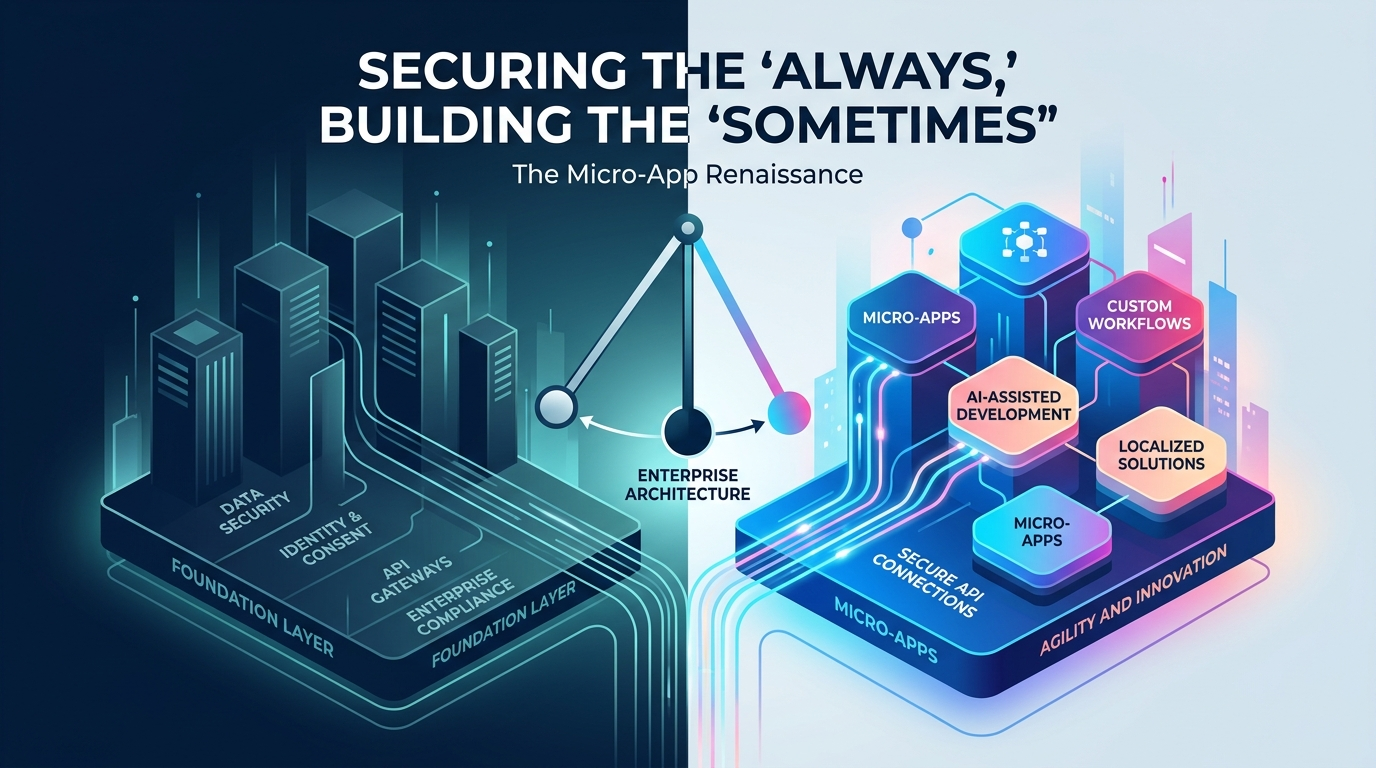
If you’ve been in the technology space long enough, you start to see the pendulum swing. Years ago, I made a living by executing a very specific, highly valuable rescue mission: liberating business logic from the fragile, tangled webs of Excel spreadsheets and Microsoft Access databases.
Back then, my weapon of choice was Microsoft Active Server Pages (Classic ASP). I was employed to build bespoke, lightweight web applications, micro-apps, that did exactly what a business needed, no more, no less. They were fast, they were custom-fit, and they solved immediate operational headaches without requiring a multi-year rollout plan.
And then, the micro-app market practically vanished. The phrase “buy vs build” started to resonate through the halls of IT.
The Rise of the Monoliths
The shift made sense from an enterprise architecture perspective at the time. The industry moved toward consolidation. "All-in-one" platforms like Salesforce (SFDC), ServiceNow (SNOW), and SAP promised to handle everything under one unified roof.
In architecture, I drive my own principle: "always" is cheap, but "sometimes" is expensive. The monoliths sold themselves on the "always." They promised a single, unified system that would always handle every process, always centralize the data, and always provide enterprise-grade security.
They delivered on that "always," but at a staggering cost. When a business needed the system to handle the "sometimes" bespoke edge-case workflows that differentiate a company, the friction was immense. The micro-app’s agility was traded for heavy governance. Simple departmental needs suddenly required extensive scoping, massive budgets, and armies of specialized consultants just to bend the monolith to the business's will. The "quick fix" was dead.
Modern Enterprise Architecture: The "Always" Value, Redefined
Today, the pendulum is swinging back, but we aren't just reverting to the fragmented days of Access databases. With today's digitally focused enterprise architecture, we can deliver that same highly coveted "always" value without the crushing weight of a monolithic platform.
We do this through an API-centric model, anchored by our data being under management. We no longer need a massive SaaS platform to serve as the single source of truth, since we centrally control the data layer. When your data is properly managed and accessible through APIs, the applications built on top of it can be as temporary, localized, and lightweight as necessary.
Enter "Vibe Coding": The Renaissance of the Micro-App
By adopting modern data architecture, the challenges of building localized apps have disappeared, ushering in the era of "vibe coding." This is a paradigm in which developers use natural language and AI models to quickly generate, iterate on, and deploy code using established APIs.
An experienced advanced user who understands the underlying business logic can now sit down, describe the required workflows, and have AI generate the boilerplate and the UI in minutes. Whether you're setting up a workflow tool with a Node.js backend or visualizing data with Python, the time-to-value is remarkable. You're no longer battling syntax or worrying about data silos; you're simply directing the logic. To be clear, this is not the reckless 'vibe coding' of amateurs blindly trusting AI outputs. Because the user is grounded in business logic and the data is secured at the API layer, this is highly disciplined, architect-led orchestration.
Why the Micro-App Wins Today
This isn't just a return to the past; it's a major upgrade. The modern micro-app, accelerated by AI and supported by solid data management, provides clear advantages over trying to force every process into a large system like SAP or Salesforce.
- Speed to Value: What used to take months of configuration in a mega-platform can now be built and deployed as a standalone app in days.
- Hyper-Customization: You aren't forcing your business process to conform to a vendor's data model. The app operates according to how your business functions.
- Lower Total Cost of Ownership: AI-assisted coding significantly cuts down development time, and modern cloud hosting makes running these lightweight apps extremely affordable.
- Integration without Assimilation: Modern micro-apps live on the edge, handling the messy, specific, human tasks ("the sometimes"), while securely pushing and pulling from your centrally managed data APIs ("the always").
The Governance Reality: Securing the "Sometimes"
Skeptics of the micro-app renaissance often raise security concerns. They recall the shadow IT days of unpatched servers under desks and custom applications with little or no access controls. But modern API-centric architecture completely reverses this narrative.
Let’s look at a practical example: building a custom application for a specific, short-lived marketing activation, such as a regional pop-up event or a highly targeted, interactive digital campaign.
This campaign needs a unique user flow, specific data capture mechanisms, and customized logic that applies only to the event's three-week duration. Trying to force that logic into a generic CRM like Salesforce as a permanent custom object is a classic example of an expensive, painful "sometimes." It clutters the core platform for a temporary need.
Today, instead of customizing the monolith, a user can use vibe coding to rapidly generate a lightweight micro-app—perhaps using Python or plain JavaScript and HTML, to handle the specific activation logic. But here is the critical distinction for governance: the micro-app owns the logic and user experience, but not the core data.
- Identity and Consent as a Service (The "Always"): The temporary marketing app doesn't create a new, separate set of user credentials or preferences. Instead, it integrates with the central enterprise Customer Identity and Access Management (CIAM) system. The enterprise retains full control over user consent, privacy compliance, and global data policies.
- API Gateways and Scoped Access: When the app needs to record a new lead, capture event engagement, or look up an existing customer's status, it makes a request through an enterprise API Gateway using a strictly scoped token. It writes newly captured marketing data directly into the central system of record via API, never hoarding it locally.
- Ephemeral Lifecycles: Because data is instantly routed to the central data layer, the micro-app itself is completely disposable. When the three-week marketing activation concludes, there's no need to untangle orphaned code or deprecate custom fields in your CRM. Just revoke the API token, shut down the hosting instance, and delete the app.
The enterprise maintains the strong, heavily controlled "always" at the data and identity layers, while the marketing team benefits from the fast, highly tailored "sometimes" at the presentation layer. It is the ultimate architectural win-win.
The New Vanguard: Orchestrators and Problem Solvers
Ultimately, this micro-app renaissance fundamentally redefines roles within enterprise IT. We are moving away from an era of platform gatekeepers and returning to an era of agile problem solvers, but with mature guardrails.
For the enterprise architect, the job is no longer about forcing every unique business unit into a rigid, monolithic box. The role is elevated to that of a strategic orchestrator. The architect's primary mandate is to design and fiercely defend the "always"—the robust data fabric, the API gateways, and the identity models. By securing this foundation, they empower the business to safely and rapidly build the "sometimes."
For developers, and increasingly for business technologists empowered by AI, "vibe coding" elevates the daily work from wrestling with boilerplate syntax to pure logical design. When the technical friction of creating a web app disappears, the focus shifts entirely to the quality of the business logic and the user experience. You are judged on how well you understand the business problem, not how well you memorized a framework's documentation.
The micro-app is back. But this time, it isn't a shadow IT liability hidden under a desk. Backed by modern data management and accelerated by AI, it is the sharpest, most responsive tool in the modern enterprise arsenal. The pendulum has swung. By locking down the 'always,' the builders are finally free to safely engineer the sometimes.